Not required under the guidelines, as long as your product is not depicted realistically. Unreal depictions fall outside Article 50(4) if they have no potential to mislead. The guidelines mention dragons and elephants driving cars (para. 113 ii), and give mice arguing about the best cheese in a cheese ad as an example of something that is not a deep fake (example box after para. 116).
Labelling not required under the guidelines
Unreal depictions are not covered if they cannot deceive anyone. The guidelines mention dragons or mice arguing in a cheese ad.
Rn. 113 ii · Beispiele nach Rn. 116
This classification follows the European Commission's guidelines on Article 50 AI Act. The guidelines are not binding; only the Court of Justice of the EU can interpret the law bindingly. You make the decision.
The example
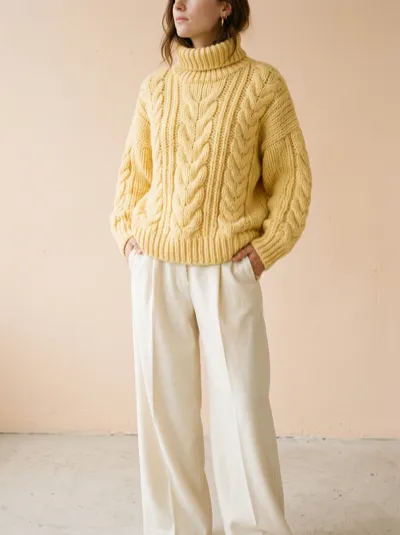
A tea store commissions a comic-style banner for its winter range, showing a little dragon brewing tea in a cave over its own fire. The tea tins appear only as drawn shapes without a real label.
The answers in the labelling check
- Was an AI tool used to create or change this image?
Yes - Who used the AI tool?
Me or someone on my team - When was the image created or last changed with AI?
On 2 August 2026 or later - What did the AI do to this image?
It generated the whole image. - How does the image look to someone seeing it for the first time?
Clearly unreal: comic, illustration, fantasy creature, physically impossible - Is the product shown realistically, so that customers could infer its appearance, size or properties?
No
Adapt these answers in the labelling check
When the result changes
- If your product is depicted realistically in an unreal setting, so customers could infer its appearance, size or properties, labelling is recommended.
- If the image looks like a real painting or drawing, labelling is also recommended, because artworks count as objects too (para. 113 iii, AI art print).
- A drawn figure is not a realistic person (para. 113 iii), but a photorealistic AI model is (AI model).
- If the image looks like a photograph, see AI product image.
What to do
- Check whether your product is realistically recognisable in the image, for example by its label, shape, size or colour, and record why the image is clearly unreal.
- If you label voluntarily, “AI-generated” is accurate, because the whole image was generated.
Frequently asked questions
The image is entirely AI-generated. Why is a label not required?
Because Article 50(4) only covers deep fakes, that is content that would falsely appear to be authentic or truthful (Article 3(60) AI Act, para. 113 iv). A clearly unreal image does not.
What does the Wettbewerbszentrale say?
Its guide (version 2.0) gives a woman drawn in comic style and an AI fantasy creature such as a minotaur as examples that do not need a label.
What if children are part of the audience?
The guidelines require taking the whole foreseeable audience into account, including children (para. 115). If an image is not clearly unreal to children, choose “Not sure” in the labelling check.
Sources
Para. refers to the paragraph number in the European Commission's guidelines on Article 50, C(2026) 5054.
- Commission Guidelines on the transparency obligations under Article 50 AI Act, C(2026) 5054 finalEuropäische Kommission · Commission · 20 Jul 2026
- Regulation (EU) 2024/1689 (AI Act)EUR-Lex · Law · 12 Jul 2024
- Wettbewerbszentrale, guide on labelling AI-generated content, version 2.0Wettbewerbszentrale · Association · 29 Jul 2026

 AI-generated