Yes, but in a lighter form. Under the guidelines a photorealistic AI image is a deep fake (paras. 113, 114). For evidently artistic or creative works it is enough to disclose the AI origin in a way that does not hamper the enjoyment of the work (Article 50(4), third sentence, AI Act; paras. 119, 123). The guidelines read “evidently” strictly (para. 122).
Labelling required, lighter form possible
A photorealistic AI image resembles people, objects, places or events that exist or could exist. Under the guidelines that is enough. They name an AI product image that can affect how the product is perceived as an explicit example.
Rn. 113 ii · Rn. 114 · Beispiel nach Rn. 116
For evidently artistic, creative, satirical or fictional works, a lighter obligation applies: disclose the AI origin without hampering the enjoyment of the work. If the image also has an advertising purpose, normal labelling takes precedence. The normal label stays on.
Art. 50 Abs. 4 Satz 3 KI-VO · Rn. 119 · Rn. 122 · Rn. 123
This classification follows the European Commission's guidelines on Article 50 AI Act. The guidelines are not binding; only the Court of Justice of the EU can interpret the law bindingly. You make the decision.
The example
A poster store sells photorealistic AI landscapes as art, such as mist over a mountain lake that does not exist.
The answers in the labelling check
- Was an AI tool used to create or change this image?
Yes - Who used the AI tool?
Me or someone on my team - When was the image created or last changed with AI?
On 2 August 2026 or later - What did the AI do to this image?
It generated the whole image. - How does the image look to someone seeing it for the first time?
Like a real photo or recording - Is the image itself part of an artwork, satire or fiction, and is that immediately obvious to everyone?
Yes, the image is the artwork I sell
Adapt these answers in the labelling check
When the result changes
- If the image advertises a different product, such as a candle in front of the AI landscape, standard labelling applies (para. 122, AI product image).
- If the image looks like a real painting, labelling is recommended, because the guidelines do not decide this case explicitly (para. 113 iii).
- For comics, fantasy creatures or physically impossible scenes, a label is not required under the guidelines if they have no potential to mislead (illustration).
- A product image that shows the poster in an AI-generated room is advertising for the poster (print-on-demand mockup).
What to do
- Label each motif with “AI” and the words “AI-generated”.
- Check third-party rights if a motif resembles an existing work or a real person. The label does not protect you there (para. 124).
How the disclosure can read

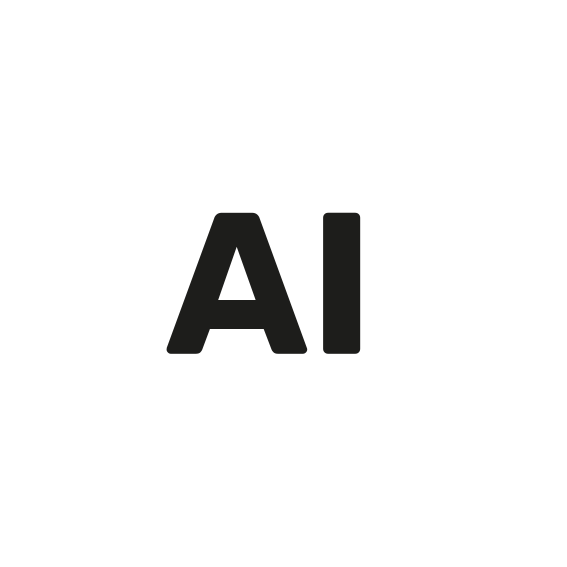 AI-generated
Label: AI · AI-generated
AI-generated image
This image was entirely generated with artificial intelligence (AI). It is not a photograph.
Create the text in 24 languages · Add the label to the image
Frequently asked questions
What does the lighter form mean in practice?
Under the Code of Practice the mark may be placed outside the image but adjacent to it, for example in the interface next to it. It must be perceivable without any dedicated action (Code, Commitment 3).
Sources
Para. refers to the paragraph number in the European Commission's guidelines on Article 50, C(2026) 5054.
- Commission Guidelines on the transparency obligations under Article 50 AI Act, C(2026) 5054 finalEuropäische Kommission · Commission · 20 Jul 2026
- Regulation (EU) 2024/1689 (AI Act)EUR-Lex · Law · 12 Jul 2024
- Code of Practice on Transparency of AI-Generated Content (final version)Europäische Kommission · Code of practice · 10 Jun 2026