
The European Commission provides three free icons for labelling under Article 50 of the EU AI Act: the basic “AI” icon, “AI GENERATED” for content created entirely with AI, and “AI MODIFIED” for content partly changed with AI, each in black and white.
Using the icons is optional; labelling a deep fake is not. The icons are not a seal and do not signal that you have signed the Code of Practice. Stores selling in languages other than English usually combine the basic “AI” icon with a short text in the customer's language.
The three icons
The icons come from the Code of Practice on Transparency of AI-Generated Content (Annex 1). The Commission has also published them on a page of their own for anyone to use. All three carry the acronym “AI” as their main element, as the Code's design rule requires: capital letters, both letters the same height, proportions preserved when resized (Measure 1.1(a)).
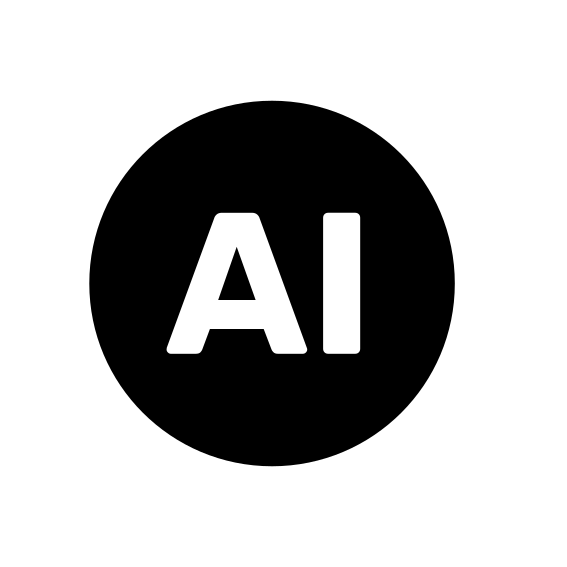
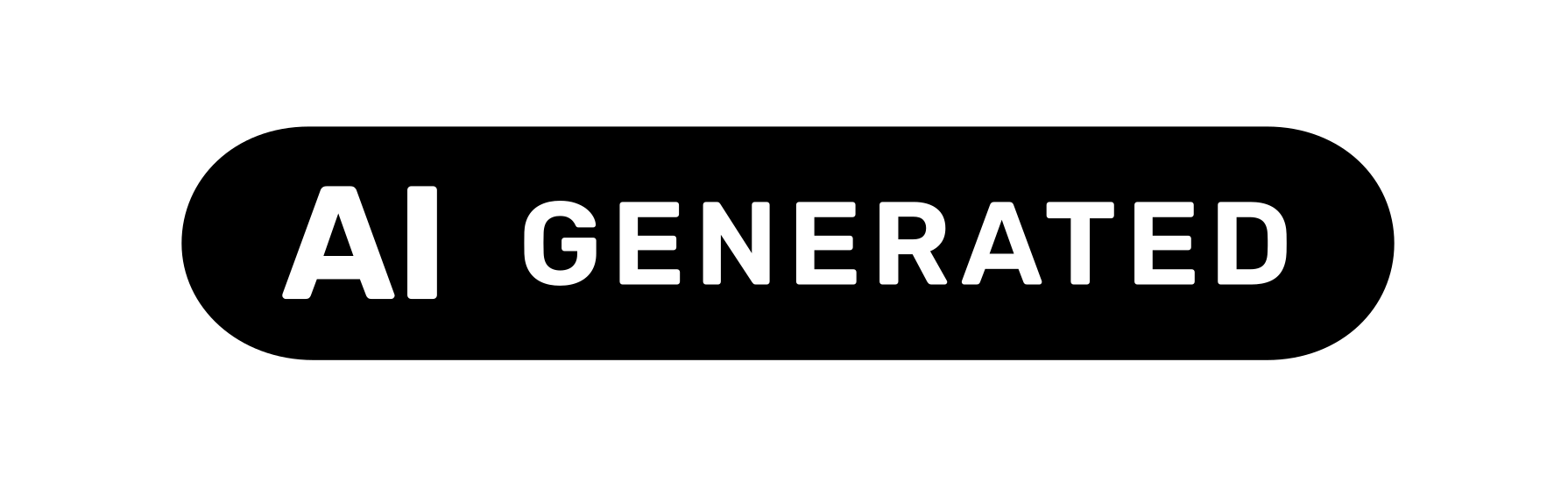
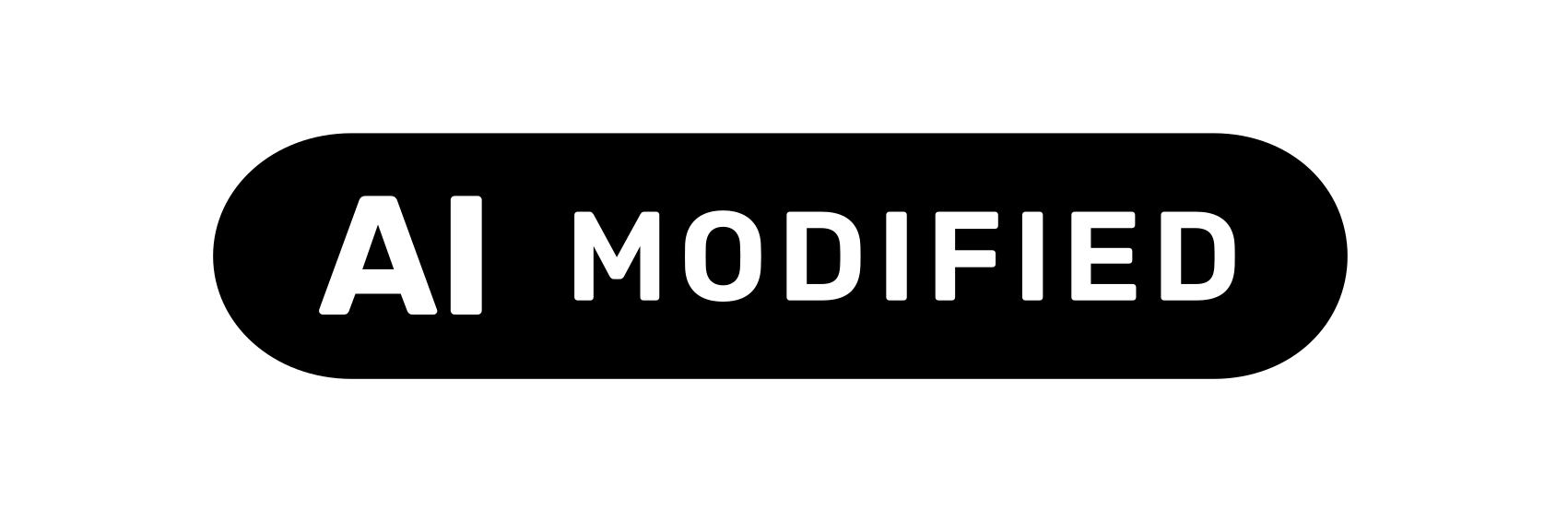
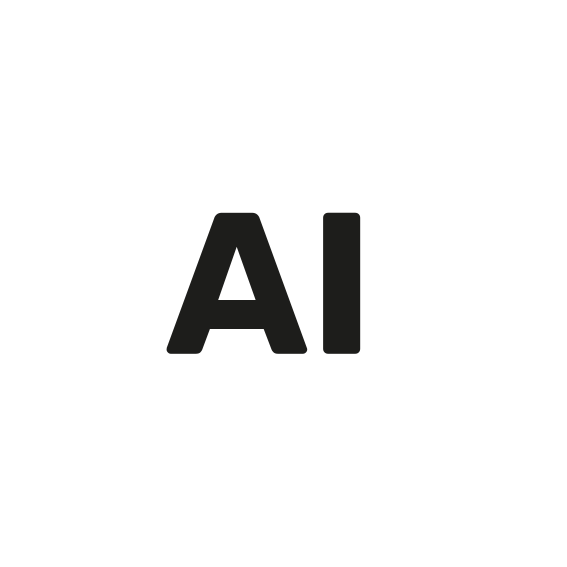
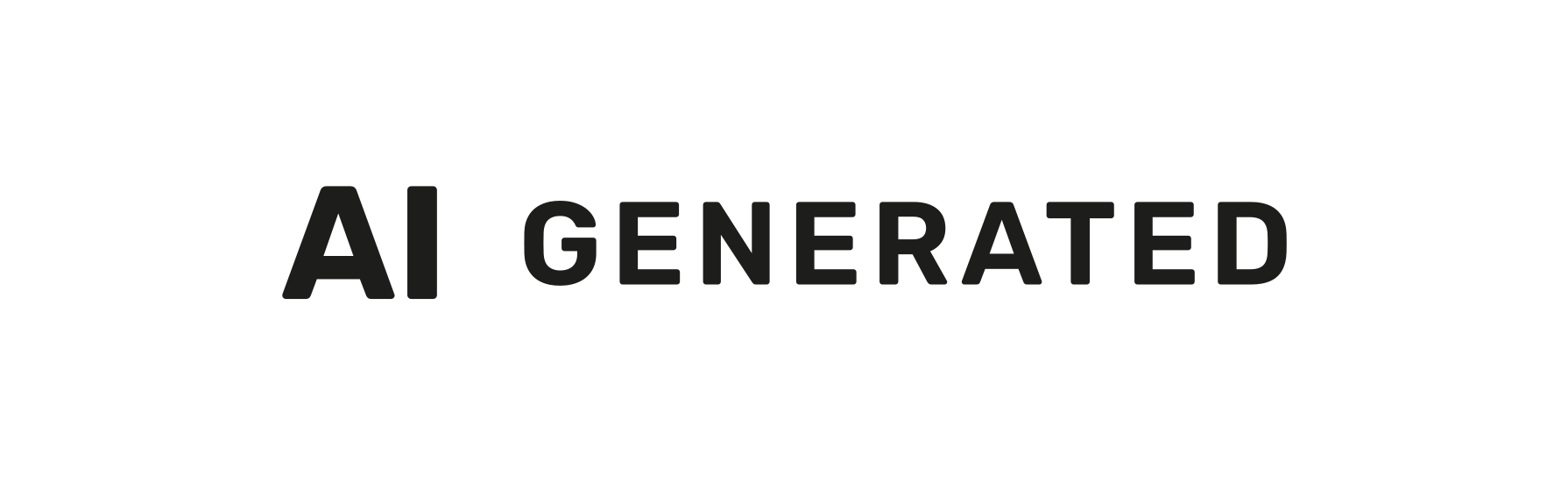
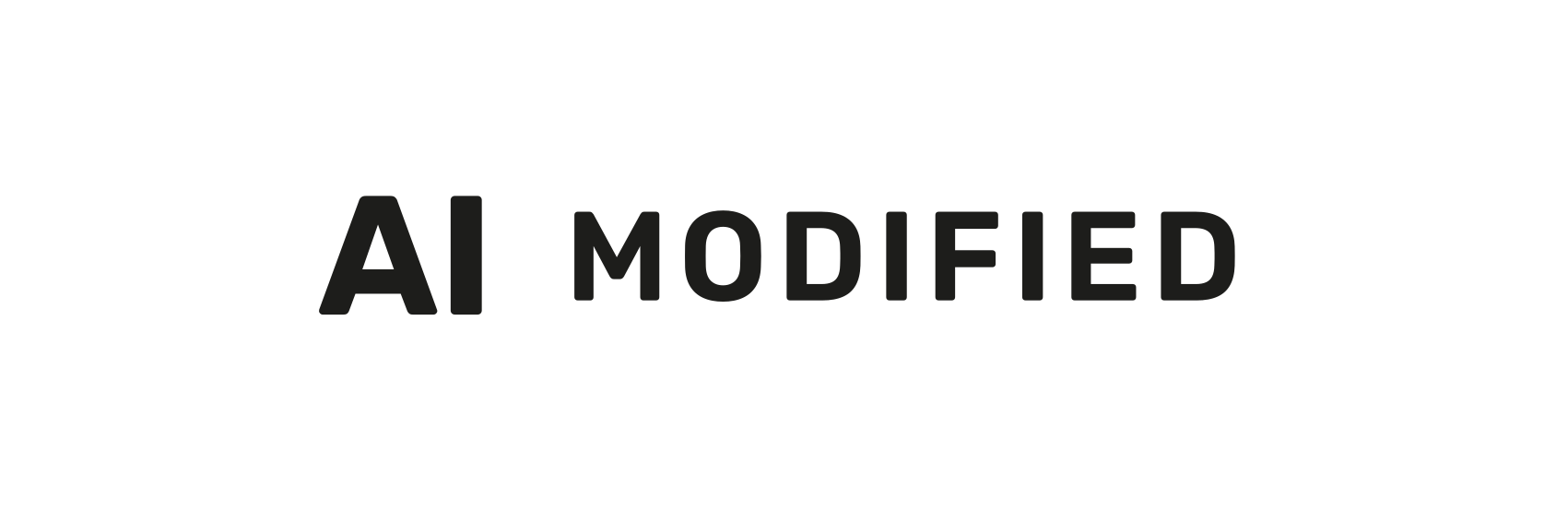
The files are shown unchanged, without the 50% transparent variants.
Which icon to use when
| Icon | When, according to the Commission | Typical store example |
|---|---|---|
| AI (basic) | When AI was involved in creating a deep fake, and when a custom text label or an interactive second layer is added. | Non-English stores: “AI” with a short text such as “KI-generiert” or “Généré par IA” next to it. |
| AI GENERATED | When the entire content was generated by AI, with no human-created elements and no human editorial control (apart from prompting). | A fully generated lifestyle image, or an AI model who does not exist. |
| AI MODIFIED | When pre-existing, human-made content was partially modified with AI, turning it into a deep fake. The Commission's example: real photos of an empty apartment furnished using AI. | A real photo in which AI changed the person, the product or the scene. |
Whether an image needs a label at all is decided by Article 50(4) of the AI Act, not by the icon. Under the guidelines, standard editing such as colour, lighting, sharpness or background removal usually does not turn a photo into a deep fake (paras. 92, 116). More in deep fakes and the labelling check.
Variants and size
According to the Commission, each icon comes in four variants, black and white, each also with 50% transparency, as SVG and PNG in one ZIP package each.
- Black or white depends on the image, because the label must remain visible “against any background” (Sub-measure 1.2.1(d)).
- The semi-transparent variants only work on calm areas of an image; otherwise the label loses the distinguishability Article 50(5) requires. The contrast benchmark is WCAG 2.1, at least 3:1 for graphical objects.
- Size is not fixed in pixels. The Commission only says: “The icon should be in a clearly visible size.” The Code allows different sizes depending on context (Measure 1.1(c)). Practical values are in AI label design.
The licence, word for word
The terms of use from the “Licence” section of the icon page:
“These icons are made publicly available for everyone to use freely, without the need for attribution to the Commission or the AI Office. However, signatories of the code of practice should use the icon in accordance with its placement specifications. Usage of these icons by non-signatories of the code should not be construed as signaling of their adherence to the code.”
European Commission, EU icons for labelling AI-generated content, “Licence” section, as of 24 September 2026
So anyone may use the icons, without signing and without attribution. Signatories should follow the Code's placement rules. For everyone else they are the obvious benchmark, because non-signatories should demonstrate compliance, for example through a comparison with the Code (guidelines para. 148, see Code of Practice). Do not give the impression that you have signed the Code.
Optional, and not a seal
On the same page the Commission makes clear what the icons do not do:
“The use of these EU icons is optional, but the labelling requirements under Article 50 AI Act are not. The use of these icons does not establish legal compliance by itself. Deployers remain responsible for ensuring that any disclosure meets the requirements of Article 50 AI Act.”
European Commission, EU icons for labelling AI-generated content, as of 24 September 2026
The icon only says that AI was involved. It is not an award and not a sign of approval by the Commission, and advertising it as such may be misleading. It only works when placed correctly: visible without a click, at the latest at first exposure and in a place free of overlapping elements (Code Sub-measures 1.2.1(a), 1.2.1(d) and 1.2.2(a)).
Embedded or overlaid
According to the icon page, the icon should be embedded unless alternatives such as an overlay are available, and it “must be visible when content is reshared or downloaded”. What counts is the text of the Code, which expressly allows an overlay and asks only for best efforts along the distribution chain (Sub-measure 1.2.1(c)). For channels outside your store, a version with the label inside the image is the cautious choice.
Do not alter the icons
The licence does not expressly forbid recolouring. We still advise against it, because an altered Commission graphic easily leads to disputes. If black and white do not suit your design, create an equivalent label of your own, which Commitment 1 also allows. The Code leaves room for contrast, colour and typography, as long as the label remains “clear, accessible, and distinguishable” (Measure 1.1(c)). The Commission's opinion also describes both routes, three common icons and common design specifications for custom labels (C(2026) 4839, para. 35).
A lower-case “ai”, distorted proportions or a label in which “AI” is no longer the main element do not fit the Code (Measure 1.1(a)).
Basic icon plus text in your language
“AI GENERATED” and “AI MODIFIED” carry English text. For stores selling in another language, the basic icon is usually the better choice, since the Commission intends it for a custom text label.
| Case | Icon | English text | German text |
|---|---|---|---|
| fully generated with AI | AI | AI-generated | KI-generiert |
| partially modified with AI | AI | AI-modified | Mit KI verändert |
The Code requires the English acronym as the main element and allows the national language only where English is incompatible with national language laws (Measure 1.1(a)). The local text is added to “AI”; it does not replace it. The user tests in the Code support the addition, as variants with a clear text label such as “modified” performed significantly better (Annex 1). Text labels in 24 languages come from the disclosure text generator.
Download
The icons in black and white are available unchanged as SVG and PNG from EU AI icons and label templates. The labelling tool places them on an image, in your browser and without upload.
Frequently asked questions
Do I have to use the EU icons?
No, they are optional. An equivalent label of your own works if it meets the Code of Practice, with “AI” as the main element, clearly visible and distinguishable. What Article 50(4) of the AI Act requires is labelling the deep fake itself.
Which icon fits an AI model?
“AI GENERATED” for a fully generated image, “AI MODIFIED” for a real photo in which AI changed or replaced the person. Stores in other languages usually take the basic “AI” icon with a short local text next to it.
Does the EU icon show that my store signed the Code?
No. Under the licence, use by non-signatories should not be read as adherence to the Code.
May I recolour the EU icons?
The licence does not expressly forbid it. We recommend using the Commission's variants unchanged and designing an equivalent label of your own if you need other colours.
Are there versions in other languages?
No, all three carry the English “AI”. Combine the basic icon with a text in your customers' language.
Sources
Para. refers to the paragraph number in the European Commission's guidelines on Article 50, C(2026) 5054.
- EU icons for labelling AI-generated contentEuropäische Kommission · Commission · 24 Sept 2026
- Code of Practice on Transparency of AI-Generated Content (final version)Europäische Kommission · Code of practice · 10 Jun 2026
- Commission Opinion on the adequacy of the Code, C(2026) 4839 finalEuropäische Kommission · Commission · 8 Jul 2026
- Regulation (EU) 2024/1689 (AI Act)EUR-Lex · Law · 12 Jul 2024
- Commission Guidelines on the transparency obligations under Article 50 AI Act, C(2026) 5054 finalEuropäische Kommission · Commission · 20 Jul 2026
- W3C, Web Content Accessibility Guidelines (WCAG) 2.1W3C · Standard · 5 Jun 2018