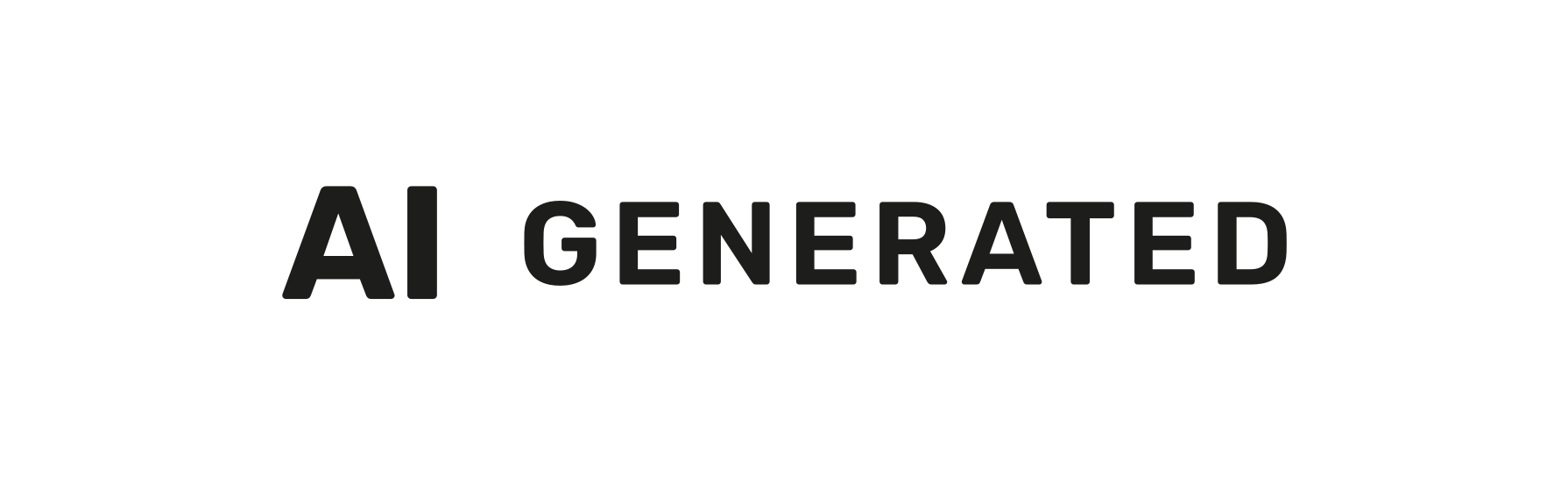
An AI disclosure statement is a page in your store that explains which sign you use for AI images and what “AI-generated” and “AI-modified” mean. The Code of Practice recommends publishing this kind of information (Measure 2.1, “encouraged”).
It does not replace the label on the image, because a notice only in your terms, menus or a manual is not enough under the guidelines (para. 142).
What the statement is for
The label on the image shows that AI was involved; the statement says what the sign means. The Code of Practice encourages you to describe your labelling publicly and in plain terms:
“Signatories are encouraged to publish information on the disclosure solution they apply in a clear and accessible manner.”
Code of Practice on Transparency of AI-Generated Content, Measure 2.1
If you use your own label instead of the EU icon, the Code encourages a similar description, ideally with pictures and the meaning of each variant (Measure 2.1).
The statement does not replace the label on the image. Under the guidelines, information is not clear and distinguishable if it is easily missed, for example when it is “only included as part of a manual or hidden under layers of menu options on an online interface, part of terms of use that are often not read by users” (para. 142). Every deep fake therefore needs its own label on the image, visible without a click and at the latest at first exposure. A general sentence such as “We use AI images in our store” is not enough either, because it does not say which image is affected (compare para. 38).
Template text in English
Adapt the parts in square brackets and drop sentences that do not apply, such as the one about clicking if your label has no second layer.
In our store, we mark images that were generated or modified with artificial intelligence (AI) with the sign ‘AI’.
‘AI-generated’ means the image was created entirely with AI. ‘AI-modified’ means a photo was edited with AI, for example the background or a person.
Click or tap the sign to see what was changed.
We follow Article 50 of the EU Artificial Intelligence Act and the European Commission's guidelines.
Have you noticed an image whose label is missing or wrong? Write to us at [email address or link to form]. We review every report and correct mistakes.
Last updated: [date]
Use the words that appear on the image, so customers recognise the sign. A picture of a labelled image helps more than any description.
Template text in German
The terms “KI-generiert” and “Mit KI verändert” match the text we use on German labels.
In unserem Shop kennzeichnen wir Bilder, die mit künstlicher Intelligenz (KI) erzeugt oder verändert wurden, mit dem Zeichen ‚AI‘.
‚KI-generiert‘ heißt: Das Bild wurde vollständig mit KI erzeugt. ‚Mit KI verändert‘ heißt: Ein Foto wurde mit KI bearbeitet, zum Beispiel der Hintergrund oder eine Person.
Ein Klick auf das Zeichen zeigt, was verändert wurde.
Wir orientieren uns dabei an Art. 50 der EU-Verordnung über künstliche Intelligenz und an den Leitlinien der EU-Kommission.
Ist Ihnen ein Bild aufgefallen, dessen Kennzeichnung fehlt oder nicht stimmt? Schreiben Sie uns an [E-Mail-Adresse oder Link zum Formular]. Wir prüfen jeden Hinweis und korrigieren Fehler.
Stand: [Datum]
The disclosure text generator produces texts for label, second layer and alt text in all 24 official EU languages.
What does not belong in the statement
- No promise of legal compliance and no claim of approval by the Commission. The store cannot prove either, and both can be misleading.
- No signature of the Code that does not exist. According to the Commission, using the EU icons does not signal adherence to the Code (see EU AI icons).
- No soft wording such as “AI-optimised” or “AI-assisted” in place of “generated” or “modified”. The label discloses origin; it does not rate quality.
Where to put it
- A page of its own in your store, for example “How we label AI images”, which in Shopify is a normal page under Online Store, Pages.
- Link it in the footer, next to your legal notice and privacy policy, where customers look for this kind of information.
- Link it from the label's second layer as “More about labelling”. That way the statement reaches the customers who have a question about an image.
- Keep it accessible with real text rather than an image, and alt text for pictures of the label.
What the label on the image should look like is covered in AI label design.
Checklist: your internal procedure
From signatories, the Code also requires an internal procedure (Measures 2.1 to 2.3, “will”). Measure 2.1 reads, in its core:
“Proportionate to their size, available organisational resources, and capacities, Signatories will put in place or maintain appropriate internal compliance processes and documentation that specifies how they implement the disclosure obligations using the icon or equivalent label.”
Code of Practice, Measure 2.1
Non-signatories can use the same points to show how they implement labelling, which is what the guidelines expect (para. 148). A small store needs clear answers to the questions below, written down on one page.
| Item | What you define | Basis |
|---|---|---|
| Responsibility | Who decides whether an image gets a label, and who applies it? Who stands in for that person? | Measure 2.1 |
| AI tools and contractors | Which tools, freelancers and agencies generate or edit images for you, and on whose instructions? | Measure 2.1 |
| Check before publishing | Every new image is checked before upload: was AI involved? Is it a deep fake? Is the label visibly in place? | Measure 2.1 |
| Record | Per image: decision, short reason, date and person. Plus a few real examples of the label in use, as screenshots. | Measure 2.1 |
| Spot checks in the live store | Where AI is used regularly: check at fixed intervals that labels display correctly, also after theme changes. | Measure 2.1 |
| Briefing | Everyone involved in labelling knows the duty and the process, including external contractors. | Measure 2.2 |
| Correction process | Missing or wrong labels are corrected without undue delay. The change is recorded. | Measure 2.3 |
| Reporting link | Customers can report a missing or wrong label, for example through the sentence in the template or a link in the label's second layer. | Measure 2.3 |
| Request from an authority | Who replies if the market surveillance authority asks about your labelling practice? Where are the record and the gap analysis kept? | Measure 2.3, para. 148 |
Measure 2.3 also requires reviewing reports: “Signatories will review cases that have been reported in a substantiated manner as mislabelled or incorrectly labelled and take measures to remedy cases of non-compliance with Article 50(4) and (5) without undue delay.” In Germany, the competent market surveillance authority is the Federal Network Agency (Bundesnetzagentur, section 2(1) KI-MIG). Comparing your setup with the Code point by point is covered in Code of Practice.
Our Shopify app keeps a record of every decision for each image, which covers the “record” item. Responsibility, the pre-publication check and the correction process are yours to define.
Frequently asked questions
Do I need a page about AI labelling?
The Code of Practice recommends one (Measure 2.1, “encouraged”). What deep fakes require is the label on the image (Article 50(4) and (5) of the AI Act); the page explains it.
Is a notice in my terms and conditions enough?
No. Under the guidelines, information placed only in terms of use, a manual or hidden in menus is not clear and distinguishable (para. 142).
May I change the template text?
Yes, adapt it to your store and to the wording of your label. Do not claim legal compliance, approval by the Commission or a signature of the Code that does not exist.
Where should I link the statement?
In your store's footer next to the legal notice and privacy policy, and, if your label has a second layer, there as “More about labelling”.
Does a small store need to document an internal procedure?
From signatories, the Code requires processes and documentation proportionate to their size and resources (Measure 2.1). Non-signatories should demonstrate compliance by other adequate means under the guidelines (para. 148). A short written procedure and a record per image serve that purpose.
Sources
Para. refers to the paragraph number in the European Commission's guidelines on Article 50, C(2026) 5054.
- Code of Practice on Transparency of AI-Generated Content (final version)Europäische Kommission · Code of practice · 10 Jun 2026
- Commission Guidelines on the transparency obligations under Article 50 AI Act, C(2026) 5054 finalEuropäische Kommission · Commission · 20 Jul 2026
- Regulation (EU) 2024/1689 (AI Act)EUR-Lex · Law · 12 Jul 2024
- EU icons for labelling AI-generated contentEuropäische Kommission · Commission · 24 Sept 2026
- German AI Market Surveillance and Innovation Act (KI-MIG)Bundesgesetzblatt 2026 I Nr. 223 · Law · 28 Jul 2026